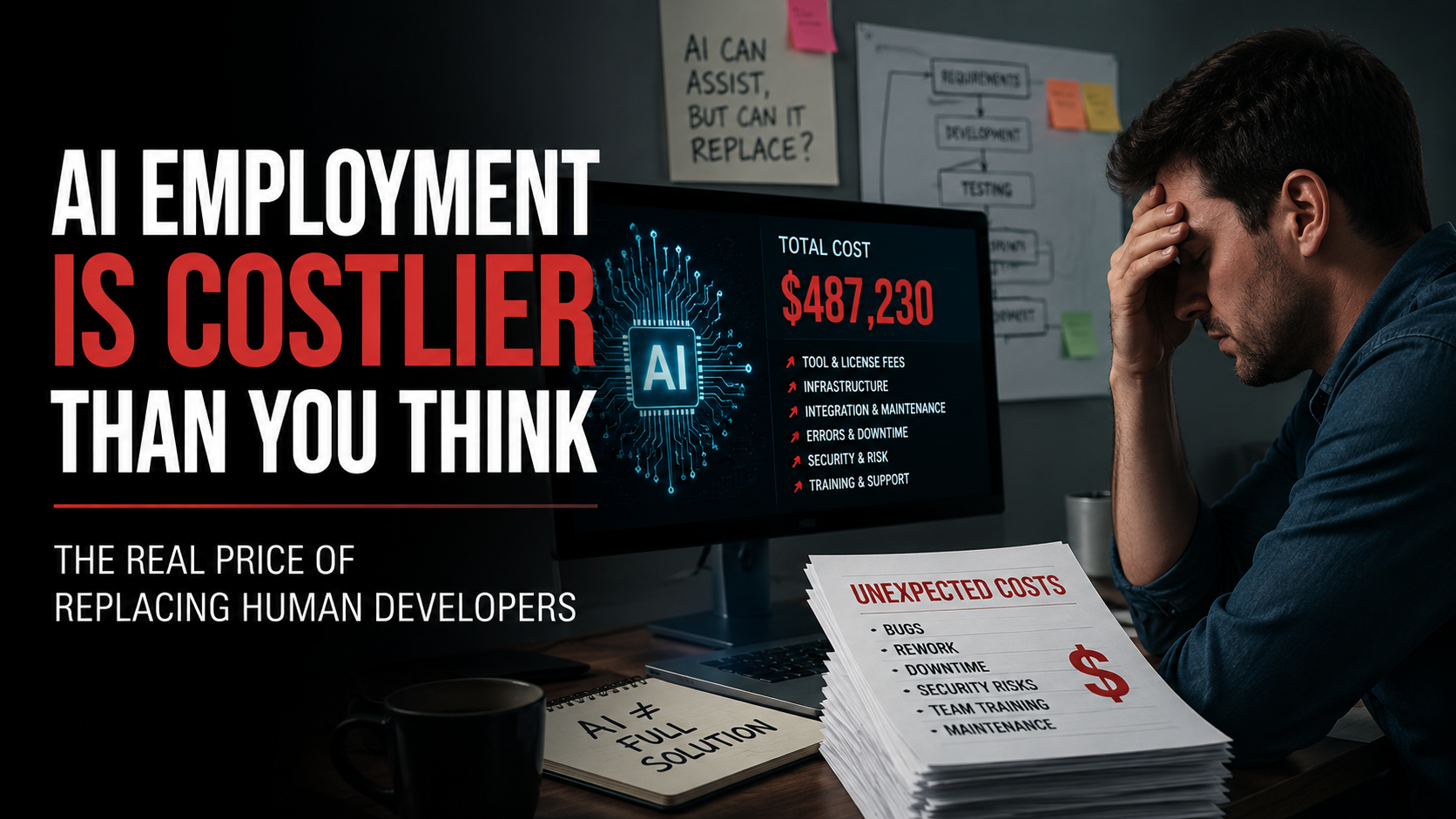
The Narrative We've Been Sold
Open any tech newsletter from the past two years and you'll find the same breathless headline:
"AI will replace developers and slash software costs by 80%."
It's a seductive idea. Why pay a senior engineer $150,000/year when an AI can write code in seconds? Boards love it. Investors love it. CFOs love it.
There's only one problem: it's not true in practice.
After real-world deployments, post-mortems, and honest cost accounting, a growing number of engineering leaders are discovering that AI employment — when done right — is substantially more expensive than keeping skilled human developers on the payroll.
This post breaks down exactly why.
The Visible Costs of AI vs. the Invisible Ones
When people compare AI to human developers, they typically compare:
| Item | Human Developer | AI (e.g., Copilot / GPT-4 API) |
|---|---|---|
| Monthly salary | $8,000–$18,000 | $20–$500 |
| Benefits & equity | $2,000–$5,000 | $0 |
| Office / hardware | $500–$1,000 | $0 |
On paper, AI wins easily. But this comparison is fundamentally incomplete. It only looks at the invoice, not the total cost of deployment.
The Hidden Costs Nobody Talks About
1. 🏗️ Infrastructure & API Costs Scale Brutally
Running an LLM at production scale is not cheap. Every API call costs money, and token consumption explodes as your codebase and prompt engineering grow.
A company running a mid-sized SaaS product with AI-assisted features can easily spend:
- $5,000–$40,000/month on OpenAI or Anthropic API calls alone
- Additional $2,000–$10,000/month on GPU cloud instances if self-hosting
- $500–$3,000/month on vector databases (Pinecone, Weaviate, Qdrant) for RAG pipelines
A senior developer at $14,000/month starts to look like a bargain.
2. 🧑💼 You Still Need Human Oversight — Always
This is the part the AI hype machine conveniently omits. AI doesn't work autonomously. Every production AI system requires:
- AI Engineers to build and maintain the pipelines
- Prompt Engineers to tune system prompts and manage context windows
- QA Engineers to catch hallucinations before they reach production
- Security Engineers to audit AI-generated code for vulnerabilities
- DevOps to manage model deployments and rollbacks
You're not replacing a developer with AI. You're adding an AI system on top of your existing developer headcount. The team gets bigger, not smaller.
3. 🐛 Hallucination Debt: The Silent Budget Killer
AI models hallucinate. They write plausible-looking code that:
- Uses deprecated APIs that no longer exist
- Introduces subtle security vulnerabilities (SQL injection, insecure deserialization)
- Passes all unit tests but fails in edge cases
- Silently breaks on data it wasn't trained on
Every hallucination that reaches production becomes a bug fix sprint, incident report, and customer trust issue. These costs are real and they compound.
A senior human developer with domain context almost never introduces hallucinated code. They ask clarifying questions, say "I'm not sure," and escalate when needed.
4. 🔄 Context & Continuity Overhead
Human developers carry institutional knowledge. They remember:
- Why that weird
setTimeout(fn, 0)hack exists in the payment service - What the client said in a meeting eight months ago about compliance
- That the legacy auth module panics if you change the session key format
AI has no persistent memory across sessions (without expensive context engineering). Every new conversation starts from scratch. Teams spend enormous time crafting context documents, writing detailed prompts, and maintaining knowledge bases just so the AI can function.
That context maintenance overhead is a full-time human job.
5. 📉 Productivity Regression on Complex Problems
AI shines at well-scoped, documented, straightforward tasks:
- Boilerplate generation ✅
- Writing unit tests for a given function ✅
- Translating code between languages ✅
But on complex, ambiguous, system-level problems — the tasks that actually define senior engineering — AI underperforms:
- Designing a distributed system that handles 10M events/day with <50ms latency
- Debugging a race condition that only appears under specific load patterns
- Refactoring a 5-year-old monolith without breaking 300 integration points
These problems require reasoning, intuition, experience, and deep contextual understanding. Current LLMs give you plausible-sounding answers that miss the real constraint. A human with 7 years of distributed systems experience sees the problem in minutes.
6. 💸 Licensing & Tooling Costs Stack Up
Beyond raw API costs, AI-augmented teams typically pay for:
| Tool | Monthly Cost |
|---|---|
| GitHub Copilot Business | $19/user/month |
| ChatGPT Team / Enterprise | $25–$60/user/month |
| Cursor Pro | $20/user/month |
| AI code review tools | $30–$100/user/month |
| AI security scanners | $200–$2,000/month |
For a team of 20 developers, these line items alone add $10,000–$30,000/month in additional tooling costs that didn't exist three years ago.
A Real-World Cost Comparison
Let's compare two hypothetical teams building the same product:
Team A: 3 Senior Human Developers
- 3 × $14,000/month = $42,000/month
- Benefits + overhead = $12,000/month
- Standard tooling = $2,000/month
- Total: ~$56,000/month
Team B: 1 AI Engineer + AI Stack + 2 Developers (AI-Augmented)
- 1 AI Engineer: $16,000/month
- 2 Senior Devs: $28,000/month
- Benefits + overhead: $11,000/month
- LLM API costs: $15,000/month
- Vector DB + infra: $4,000/month
- AI tooling licenses: $3,000/month
- Prompt engineering + QA overhead: $5,000/month
- Total: ~$82,000/month
Team B costs 46% more and ships features more slowly on complex problems.
When AI IS Worth the Investment
This isn't an anti-AI argument. AI genuinely excels and saves money in specific contexts:
- High-volume, standardized code generation (e.g., scaffolding microservices from templates)
- Customer-facing AI features that create product differentiation
- Automated testing at scale
- Data pipeline generation from well-documented schemas
- Internal developer tools that augment (not replace) experienced engineers
The ROI turns positive when AI is used as a force multiplier for great developers, not as a replacement.
The Uncomfortable Truth for Engineering Leaders
The organizations winning with AI are not the ones that fired their developers and replaced them with prompts. They're the ones that:
- Kept their best engineers and gave them AI superpowers
- Invested in AI infrastructure as a product differentiator
- Measured AI ROI honestly — including hidden costs
- Built domain-specific fine-tuned models rather than relying solely on generic APIs
- Created human-in-the-loop workflows for anything touching production
AI is a technology shift, not a staffing strategy.
Conclusion: Price the Full System, Not Just the API
The next time someone in your organization says "we could save money by replacing developers with AI," ask them to price the full system:
- Who monitors the AI's output?
- Who fixes the hallucinations?
- Who maintains the prompt library and context documents?
- Who designs the system architecture the AI is generating code for?
- Who's on-call at 3am when the AI-generated payment logic fails in production?
When you price the complete picture, you often find that experienced human developers — especially senior engineers with deep domain knowledge — are not only cheaper, but also faster, more reliable, and significantly less likely to take your production system offline.
AI is remarkable. But it is not free. And it is rarely cheaper than the people it claims to replace.
Written by Om Avchar — Software Engineer passionate about backend systems, real engineering trade-offs, and cutting through tech industry hype.