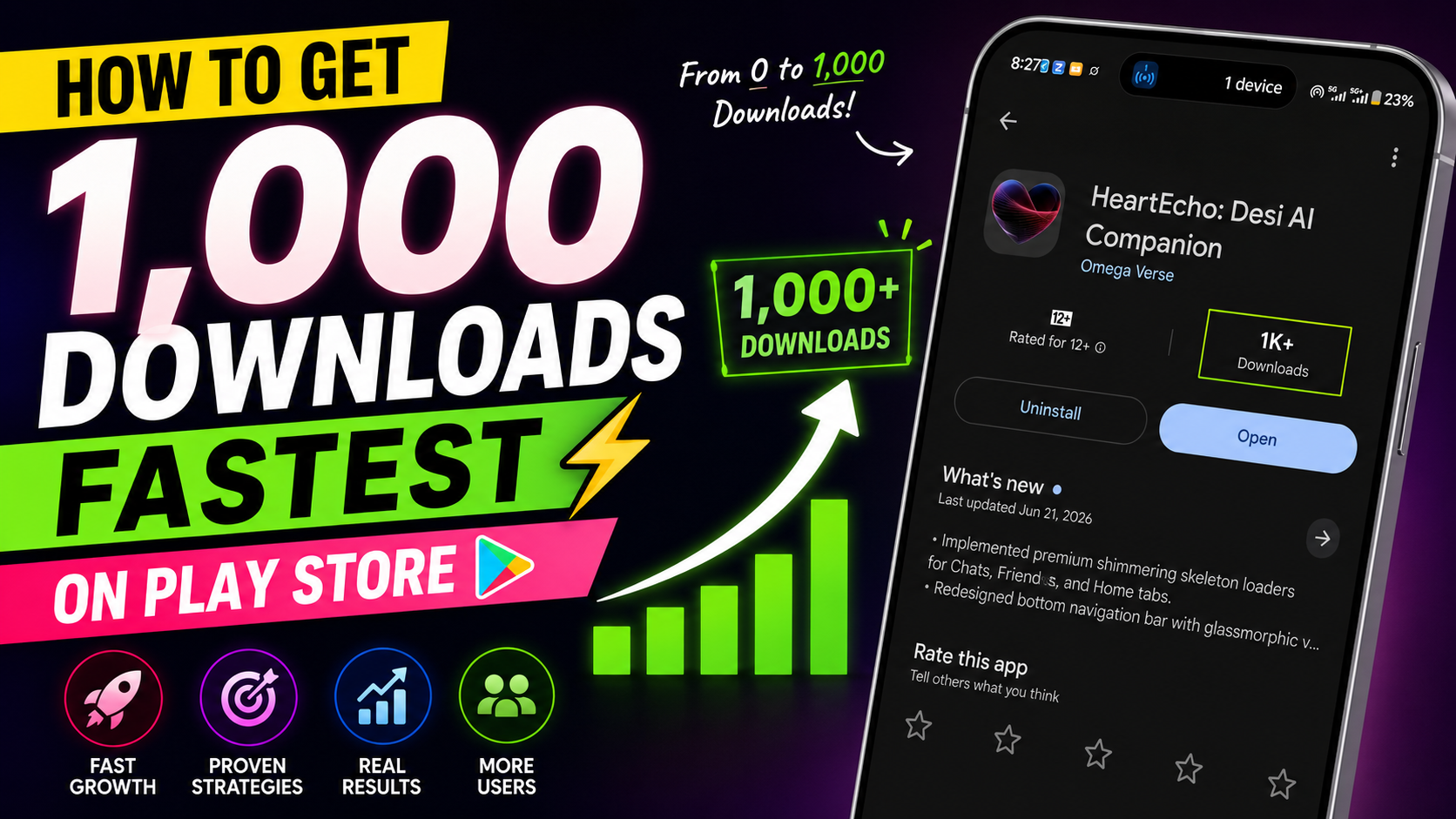
The 15-Day Milestone
Fifteen days. 1,000+ active installs. Zero dollars spent on ads.
As a solo developer working from a hostel room, hitting that four-digit mark on the Google Play Console felt surreal. If you’ve ever launched an app, you know the default state of any new release is absolute, crushing silence. You publish, you tell your parents, you message three friends, and then... nothing. The active install counter stays stuck at 5.
With HeartEcho, a Desi AI companion that chats in fluid Hinglish and Hindi, I wanted to see if a solo developer in India could break through that noise without a marketing budget.
Here is the exact, unvarnished playbook of how I did it. No fluff, no VC jargon—just the raw engineering and distribution strategies that actually moved the needle.
Finding the Unfair Advantage (The "Desi" Moat)
Most people building AI products copy whatever is trending on GitHub, wrap a generic UI around it, and call it a day. They build another English productivity tool, a PDF summarizer, or a generic chatbot.
But if you are competing globally, you are competing against teams with millions in funding and 50 engineers. As a solo dev, you need to find an angle they cannot easily target.
For me, that angle was local language patterns and cultural context.
Mainstream AI models are built with Western sensibilities. They understand English perfectly, but when you chat with them in Hinglish (a fluid mix of Hindi and English), they sound like a textbook translation. They don't understand the nuance of “bro, aaj mood bohot off hai” or “canteen ki chai is emotional support.” They don't know the stress of Indian college placements, the pressure of board exams, or the specific humor of Indian hostel life.
I built HeartEcho specifically for this demographic. I optimized the system prompts and memory constraints so the AI companions would:
- Chat naturally in Hinglish and regional slangs.
- Understand local cultural references (Bollywood, local engineering colleges, Chai culture).
- Support voice calls and interactive video actions tailored to the emotional vocabulary of young Indians.
By building for a highly specific cultural niche, I didn't have to compete with ChatGPT. I had created a product that felt like it was built specifically for the person using it.
Surviving the Dreaded "20 Testers" Hurdle
Before you can even launch an app on the Google Play Store in 2026, Google throws a massive roadblock in your way: The 20-Tester Rule.
If you have a personal developer account created after November 2023, you cannot release an app to production until you run a closed track test with at least 20 testers opted-in continuously for 14 days.
For a solo indie developer, finding 20 people who will actually download your app, keep it installed, and open it daily for two weeks is surprisingly difficult. Your friends will promise to do it, but they’ll forget by day three.
Here is how I cleared this hurdle:
- Leveraging Tester Exchange Groups: I joined Reddit communities like
r/AndroidClosedTestingand dedicated indie developer Discord servers. The rule of thumb here is simple reciprocity: “You test my app, I test yours.” - The "Warm" Circle Incentive: I set up a WhatsApp group of 15 close friends and college batchmates. To keep them engaged, I turned it into a mini-game. I shared daily logs of what the AI was saying and asked them to try to "break" the AI's logic.
- The Feedback loop: I pushed updates almost every second day during the testing phase. When testers saw their suggestions implemented within hours, they felt invested in the app's success and kept opening it.
It took exactly 16 days of coordinated effort, but we passed the review on the first attempt.
The Zero-Dollar Marketing Playbook
Once the app went live in production, the clock started ticking. I had no budget for Google Ads or influencer shoutouts. I had to rely entirely on organic channels.
Here are the three channels that drove 90% of the initial 1k installs:
1. High-Value, High-Context Reddit Posts
Most developers spam Reddit. They go to subreddits like r/developersIndia or r/india and post: "Hey, look at my new app, download it here." This is a great way to get banned or ignored.
Instead, I wrote a detailed post explaining how I built the voice call latency reduction logic using local caching and WebSockets, sharing the exact code snippets and architectural choices. I only mentioned HeartEcho at the very end as the live case study.
Because the post provided genuine value to other developers and tech enthusiasts, it got upvoted, stayed on the hot page for 36 hours, and drove our first 400+ installs within a single weekend.
2. ASO (App Store Optimization) for Search Queries
People search for very specific things on the Play Store. They don't search for "HeartEcho"—they search for what they want the app to do.
I spent hours researching search terms. I realized there was a rising search volume for queries like:
- "Hinglish AI companion"
- "AI girlfriend Hindi"
- "Virtual friend voice call"
- "Hindi AI voice chat"
I structured the Play Store title, short description, and long description to organically target these keywords without keyword-stuffing. I also localized the app store listing assets (screenshots) with bold Hinglish text overlays showing actual chat screenshots that instantly resonated with searchers.
As a result, within 10 days, HeartEcho started ranking in the top 5 search results for several high-intent Hindi AI search queries, bringing in a steady stream of 30–50 organic installs every day.
3. The Virality Loop (Micro-Animations & Shareability)
I built a feature that allowed users to easily export and share funny or emotionally resonant chat snippets as styled images.
Because the AI's Hinglish responses were often incredibly witty or humorously dramatic (tailored to Indian sarcasm), users started sharing these screenshots on their Instagram stories and WhatsApp status cards. Every shared screenshot had a tiny watermark: “Chatting with Priya on HeartEcho.” This created a small, organic viral loop that brought in high-quality users who already knew what to expect.
2 AM Server Crashes and Real Economics
Scale is beautiful until it breaks your database.
Around day 8, after a popular post went viral on a student forum, our concurrent active users spiked. At 2:30 AM, my phone started blowing up with error alerts. The LLM API costs were scaling linearly with messages, but our database connection pool was exhausted, and the API requests were timing out.
Here is the quick engineering fix I deployed under pressure:
// Before: Every message did a direct DB call to fetch full history and updated state
// After: Implemented local cache and batch database writes
const chatCache = new Map();

async function handleIncomingMessage(userId, message) {
  // 1. Fetch memory from fast cache instead of DB
  let userContext = chatCache.get(userId) || await fetchContextFromDB(userId);

  // 2. Call LLM
  const response = await callLLM(userContext, message);

  // 3. Update Cache instantly
  userContext.history.push({ role: 'user', content: message });
  userContext.history.push({ role: 'assistant', content: response });
  chatCache.set(userId, userContext);

  // 4. Queue DB write asynchronously
  queueDbWrite(userId, userContext);

  return response;
}
By caching the user's active session state in-memory and batching database writes, database load dropped by 70%, latency decreased, and the server stabilized.
On the financial side, early scaling taught me that LLM token costs can eat you alive if you aren't careful. I implemented strict context-window limits, truncating older messages and keeping only a summarized "core memory" in the prompt context. This reduced our average token cost per message by 40% without sacrificing the AI's long-term memory.
Key Takeaways for Indie Developers
If you are an indie developer looking to launch a SaaS or mobile product in 2026, here is my advice:
| Rule | The Reality | Actionable Takeaway |
|---|---|---|
| Build Local | Silicon Valley builds for the global English market. Find a local language or cultural niche. | Localize your AI prompts, UI, and copy to match the exact way people speak in your target region. |
| Solve Distribution First | A great product with zero distribution is a dead product. | Spend 50% of your time on building and 50% on finding organic distribution channels before you launch. |
| Embrace the Hurdle | Play Store testing rules and API costs are hard, but they act as a filter. | Work through the 20-tester requirement systematically by trading value in builder communities. |
| Keep Costs Extremely Low | You cannot iterate if you run out of money. | Use caching, token limits, and free-tier infrastructure. Survive long enough to find what works. |
Building HeartEcho to 1k installs in 15 days was intense, exhausting, and incredibly rewarding. The journey is far from over—we are iterating on subscription tiers, introducing custom voice models, and optimizing performance.
But if there is one thing this launch proved, it is that a single developer with a laptop and a clear strategy can still capture the attention of thousands of users.
Stop writing plans. Build the MVP, get your 20 testers, and ship it.
Written by Om Avchar — developer, indie hacker, and creator of HeartEcho.